12 Best Email Warm-Up Tools in 2026 - Features, Pros & Cons
lemwarm
May 7, 2026
|9 min read
Why email warmup matters
One in five cold email campaigns lands an open rate of 20% or less. The first thing to fix when that happens is warmup and deliverability monitoring.
Here are the 12 warmup and deliverability tools worth knowing in 2026, with pricing, features, pros, and cons for each.
lemwarm
lemwarm is an email warmup and deliverability tool built by an outbound team that runs real campaigns at scale. Full review here.
Standout features
- lemwarm score with built-in technical setup check
- 20,000+ healthy domain warmup network (Essential and Smart)
- Warmup network tailored to your industry (Smart)
- Warm up your real email templates before launch (Smart)
- Per-template spam tracking with auto-pause for risky templates
- Custom deliverability alerts and tips
- Manage multiple inboxes for the whole team in one place
Pricing
- Essential: $29/month, or $24/month billed yearly (per email)
- Smart: $49/month, or $40/month billed yearly (per email)
- Custom plan for teams with more than 10 users
- Free with any active lemlist subscription
Yearly saves 20%. Quarterly saves 10%. Full pricing: lemwarm.com/pricing.
Pros and cons
✅ Pros: spots and explains deliverability issues fast, advanced warmup features, strong price-to-value ratio, real inboxes with threaded replies.
❌ Cons: the most advanced features sit on the Smart plan, not Essential.
Folderly
Folderly positions itself as a deliverability ecosystem with several products bundled together. It analyzes your emails, flags issues, and proposes a fix plan.
Standout features: Inbox Insights checks placement, IPs, and DNS records before launch (sold separately). One-click mailbox connection. Email content analysis with recommendations.
Pricing: $120/month per mailbox monthly billing, dropping to $96/month per mailbox on annual billing for 1 to 9 mailboxes. The per-mailbox rate goes down further (around $90/month) once you hit 10 to 24 mailboxes. Inbox Insights at $79/month (or $64/month annual) with a free 2-test plan. Minimum 1-year commitment.
✅ Pros: goes beyond warmup, free trial for Inbox Insights, supports custom providers.
❌ Cons: expensive, multiple products to buy separately, learning curve, minimum 1-year commitment
Warmbox
Built for new sending domains. Network of 35,000+ inboxes and GPT-4 generated warmup emails.
Standout features: AI-generated warmup emails (GPT-4), spam score monitoring, customizable warmup based on audience, volume, and sender reputation.
Pricing (monthly billing): Solo $19/month (1 inbox, 50 emails/day), Start-up $79/month (3 inboxes, 250 emails/day), Growth $159/month (6 inboxes, 500 emails/day). Annual billing drops these to $15, $69, and $139 respectively. Custom plans for higher volume.
✅ Pros: affordable starter plan, customizable warmup, chat support.
❌ Cons: plan structure is harder to follow than it should be, copy on their website is rough in places.
Mailreach
Uses machine learning and a network of 20,000 real inboxes to warm up your sending.
Standout features: smart warming algorithm, real-inbox network, sender reputation monitoring, MailReach Co-Pilot AI deliverability assistant, multi-ESP warmup.
Pricing: All-in-One plan at $25/mailbox per month (monthly), with at least 20 spam test credits included. Annual billing saves 20%. Slider-based pricing scales with the number of mailboxes (1 to 100+). Spam tester credits can also be bought as a standalone pay-as-you-go plan.
✅ Pros: clean interface, hands-off algorithm, low technical bar, spam test credits included in the warmup plan.
❌ Cons: extra spam test credits cost on top of the included 20, no personalized warmup.
Warmup Inbox
One of the largest warmup networks at 30,000+ inboxes, with template warmup support.
Standout features: 30,000+ real inboxes, template warmup, 7-day free trial.
Pricing (annual billing): Basic $15/mailbox/month, Pro $49/mailbox/month, Max $79/mailbox/month. Half-yearly billing saves 10%, yearly saves 20%. Pay-as-you-go with no long-term commitment.
✅ Pros: free trial, solid support, custom templates, large network.
❌ Cons: basic plan is limited, no technical setup check.
Mailwarm
Basic warmup tool with no public free trial. Pricing is no longer shown directly on the website (you have to contact sales for the latest figures).
Standout features: opens, replies, and starring on warmup emails. Blacklist monitoring.
Pricing (recently reported): Starter around $69/month (1 inbox, 50 emails/day), Growth $159/month (3 inboxes, 200 emails/day), Scale $479/month (10 inboxes, 500 emails/day). 13% discount on annual billing. Extra interactions cost $0.02 each. Custom enterprise plans available.
✅ Pros: easy setup, clean interface.
❌ Cons: only basic warmup, expensive entry point, no public free trial, pricing not transparent on the website.
Warmy
Good fit for high-volume senders, with separate warmup networks for B2B and B2C providers.
Standout features: volume-based pricing, Google Postmaster integration, deliverability monitor, dedicated deliverability expert on every plan, dedicated customer success manager on the Custom plan, 7-day trial with no credit card required.
Pricing: Three plan categories on the official pricing page, all volume-based with prices behind a demo. The B2B sender plan warms up using a network of business mailboxes (G Suite, MS365), the B2C sender plan uses consumer mailboxes (Gmail, Yahoo, Outlook), and the Custom plan is tailored to your specific needs and adds a dedicated customer success manager.
✅ Pros: separate B2B and B2C warmup networks, dedicated deliverability expert included, 7-day free trial.
❌ Cons: no public dollar pricing (demo required), advanced support sits on the Custom plan only.
Inboxally
Expensive but adds engagement signals competitors skip: scrolling on long emails, link clicks, and chat support.
Standout features: scrolling on longer warmup emails, link clicks, chat support.
Pricing: Starter $149/month (1 sender profile, 100 seed emails/day), Plus $645/month (5 sender profiles, 500 seed emails/day), Premium $1,190/month (10 sender profiles, 1,000 seed emails/day), Enterprise custom (thousands of seed emails/day, unlimited sender profiles).
✅ Pros: deeper engagement actions, 10-day free trial, no DNS or mailbox access required.
❌ Cons: expensive, generic warmup content, pricing scales fast with sender profiles.
Allegrow
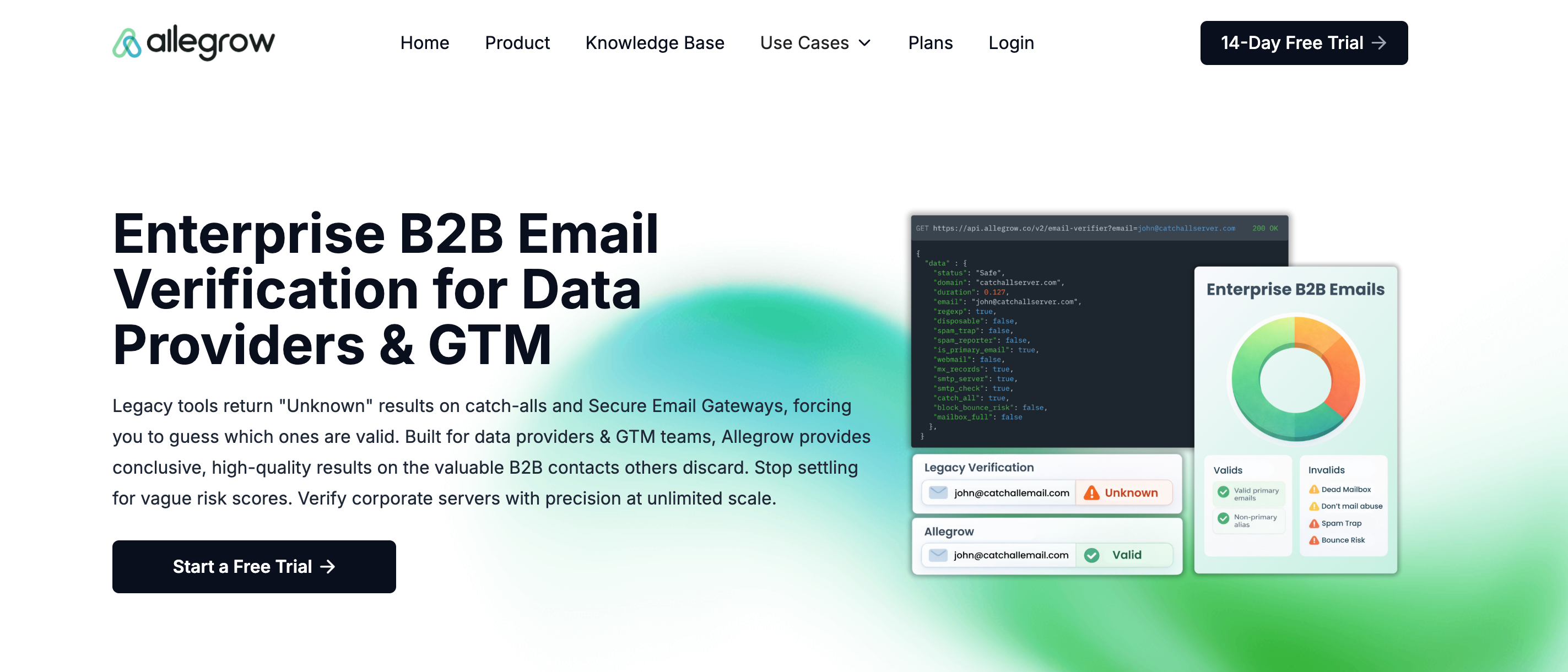
The product is now positioned as a B2B email verification platform for data providers and GTM teams (catch-all and Secure Email Gateway resolution), with deliverability and warmup as part of a wider suite rather than the core offer.
Standout features: ESP integration, Safety Net flags spammy content before sending, Deliverability Leaderboard for team-level visibility, catch-all email verification, native integrations with HubSpot, Outreach, Salesloft, and ZoomInfo.
Pricing: Starter from $99/month (5,000 verification credits included). Each extra mailbox costs $40/month, extra contacts $8 per 1,000. Scale Plus tier (unlimited verification, native CRM integrations) is around $1,340/month. 14-day free trial with up to 1,000 contacts.
✅ Pros: works inside your existing tools, catches spam pre-send, strong on enterprise B2B verification.
❌ Cons: warmup is no longer the main focus, expensive at $99+/month per mailbox if you only need warmup.
Mailivery
One of the few tools that allows unlimited inboxes, though daily warmup volume is capped.
Standout features: unlimited inboxes, team management from one dashboard, custom warmup templates, blacklist monitoring, email verification credits, P2P warmup network.
Pricing: Starters $29/month (200 warmup emails/day shared across mailboxes), Professional $79/month (800/day shared), Business $199/month (2,500/day shared). Yearly billing saves 25%. 7-day free trial on the Starters plan.
✅ Pros: unlimited inboxes on every plan, custom templates, all-in-one bundle (warmup + blacklist monitoring + verification).
❌ Cons: daily limits shared across all mailboxes, no technical setup check, generic warmup network.
TrulyInbox
Charges per email volume rather than per inbox, so you can connect unlimited accounts on every paid plan.
Standout features: 3 warmup strategies (Progressive, Random, Flat), AI-powered warmup content for 50+ industries in 12 languages, deliverability score, account health monitoring (SPF/DKIM/DMARC), custom sending schedules.
Pricing (annual billing, monthly in parentheses): Free plan (1 account, 10 emails/day), Starter $22/month ($29) for 200 emails/day, Growth $59/month ($79) for 1,000 emails/day, Scale $142/month ($189) for 3,000 emails/day, Business plan around $289/month for 6,000 emails/day. All paid plans include unlimited email accounts. 7-day free trial on paid plans, 14-day money-back guarantee.
✅ Pros: free plan, unlimited accounts on every paid plan, per-volume pricing model, multilingual AI warmup content.
❌ Cons: API access still in "coming soon" status, dedicated account manager only on Scale and above.
Mailshake
Warmup is no longer sold as a standalone Mailshake product. It's now bundled into every Mailshake plan as an unlimited feature, alongside the rest of their sales engagement suite.
Standout features: unlimited email warmup on every plan, SHAKEspeare AI email writer, multi-channel outreach across email, phone, and LinkedIn.
Pricing: Starter $29/month ($25 yearly), Email Outreach $49/month ($45 yearly), Sales Engagement $99/month ($85 yearly), Agency plan via sales. No free trial. Full pricing: mailshake.com/pricing.
✅ Pros: unlimited warmup on every plan, full sales engagement suite in one tool.
❌ Cons: no standalone warmup option, no free trial, more than you need if you only want warmup.
Email warm-up FAQ
What is email warmup?
Warmup is the gradual increase in sending volume and frequency for a new sending domain or IP. The point is to build sender reputation before you start real outreach. More on the basics here.
Send hundreds of emails from a fresh domain and inbox providers treat you like a spammer. Volume alone isn't enough either. Engagement (opens, replies, clicks) is what actually builds reputation. A good warmup tool handles both.
How long does it take to warm up an email?
TAround 3 to 4 weeks to ramp to full volume, plus 2 more weeks of stabilization at the top. So plan for a month before launching campaigns. More detail here.
And keep warmup running after that. Stop it and your reputation slips.
Can I start my campaign without warming up my email?
Yes, you can. However, expect many of your emails to land in the spam folder.
What's the right volume during warmup?
Start with a few emails per day and increase gradually. With lemwarm, you set the daily limit to 40 emails/day from the start, and the ramp builds under that ceiling automatically. Other tools have their own pacing rules. The principle is the same: gradual.
Can I warm up my email manually?
Technically yes, but it's a full-time job. Here's the manual process if you want to try.
For most teams, the cost of doing it manually is much higher than the monthly fee for a warmup tool. The math almost always favors the tool.
